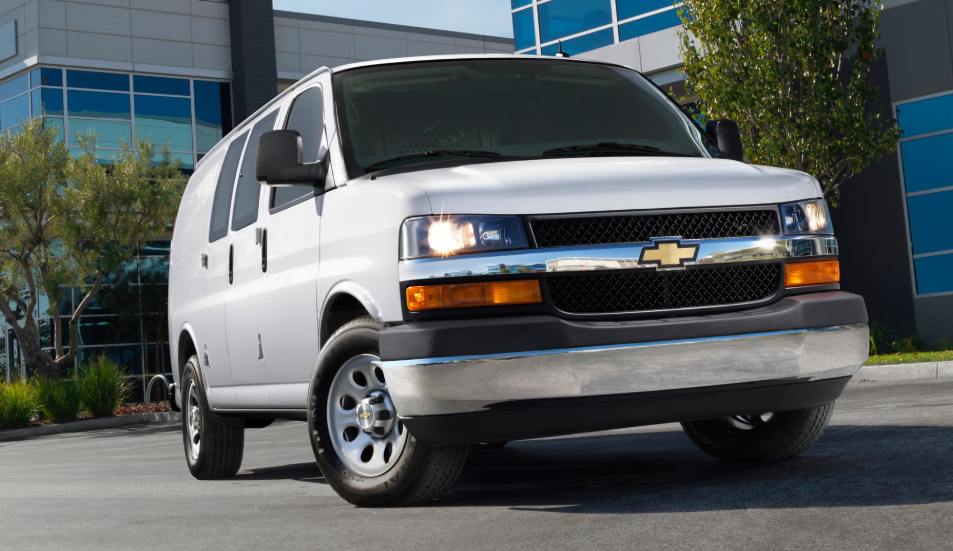
2027 Chevrolet Express Release Date & Spec – The 2027 Chevrolet Express is a carryover model with no major redesign or updates from the 2026 version. Production is scheduled to begin with the start of regular production (SORP) on August 31, 2026, at GM’s Wentzville, Missouri plant (which also builds the related GMC Savana, Chevrolet Colorado, and GMC Canyon).
Dealers could begin entering order information into systems around June 11, 2026, with actual order submissions starting about July 23, 2026. These dates are tentative and subject to change. Vehicles should begin arriving at U.S. dealerships in the fall of 2026 for the 2027 model year, following typical GM commercial-vehicle rollout patterns.
What’s New (or Not) for the 2027 Model Year?
Chevrolet has confirmed that the 2027 Express soldiers on largely unchanged. There is no facelift, interior refresh, new powertrains, or platform update. The van retains its body-on-frame design that dates to the mid-1990s (with the last significant update in 2003). This continuity appeals to fleet operators who value proven durability, easy servicing, and familiar upfit compatibility over modern styling or advanced features.
Earlier plans for an electric replacement or substantial redesign (sometimes referenced under project codes related to Ultium or GMT620) were dropped or delayed. The Express continues as a gasoline-powered work van.
Available Configurations and Trims
The 2027 lineup includes:
- Cargo Van — 2500 and 3500 (sometimes listed as 3600) series, regular and extended wheelbases, primarily in a single Work Truck (1WT) trim.
- Passenger Van — LS and LT trims, seating up to 12 (regular wheelbase) or 15 (extended) passengers.
- Cutaway — Chassis-cab versions for specialized upfits (e.g., ambulances, shuttles, school buses), with 139-inch and 159-inch wheelbases on the 3500 series. Some longer or heavier (4500) cutaway options were dropped.
Wheelbases are approximately 135 inches (regular) and 155 inches (extended). Cargo volume reaches about 239 cubic feet (regular) to 284 cubic feet (extended).
Powertrains, Towing, and Capability
Engines carry over unchanged:
- Standard: 4.3-liter V6 (LV1) producing 276 horsepower and 298 lb-ft of torque.
- Optional: 6.6-liter V8 (L8T) producing 401 horsepower and 464 lb-ft of torque.
Both pair with an 8-speed automatic transmission and rear-wheel drive only. Maximum towing is approximately 7,400 pounds with the V6 and up to 10,000 pounds with the V8 on cargo models (slightly lower on passenger versions). Payload can exceed 3,000–4,000 pounds depending on configuration, with cutaway models offering higher ratings (up to around 8,900 pounds in some setups).
These figures give the Express a clear edge in maximum towing versus many modern unibody rivals like the Ford Transit or Ram ProMaster.
Pricing Expectations and Value for U.S. Buyers
Exact 2027 MSRPs had not been fully finalized in mid-2026 reporting, but expect a modest increase over 2026 pricing. Recent 2026 figures started around $42,200–$44,595 for base cargo vans (before destination, typically ~$2,395) and higher for passenger models (roughly $47,950–$54,000+ range depending on trim and wheelbase). The Express remains one of the more affordable full-size van options in the U.S. market for pure capability and simplicity.
How It Compares to Competitors?
The Express prioritizes toughness and upfit flexibility. Rivals such as the Ford Transit, Ram ProMaster, and Mercedes-Benz Sprinter offer more modern interiors, better fuel efficiency in some cases, high-roof options, stronger standard safety tech, and (in some cases) electric variants. The Express counters with superior traditional towing, body-on-frame durability preferred by many fleets, and lower complexity.
Should You Wait for the 2027 Chevrolet Express?
For U.S. commercial buyers, fleet managers, and upfitters who need a no-nonsense, high-capability van right away—or who already operate Express/Savana fleets—the 2027 model is a safe, familiar choice with production starting late summer 2026. Those seeking modern features, better efficiency, or high-roof versatility may prefer shopping competitors or monitoring any future GM commercial-van developments.
Check with local Chevrolet dealers for exact order windows, inventory, and any regional incentives as the model year ramps up. Production and availability can shift based on supply-chain or demand factors.